library(pwr)

effects <- seq(0.2, 1, by = 0.05)
res <- sapply(effects, function(d) pwr.t.test(d = d, power = 0.8, sig.level = 0.05, type = "two.sample")$n)

plot(effects, res, type = "l", lwd = 2,
     xlab = "Effect size (Cohen's d)",
     ylab = "Required sample size per group",
main = "Smaller effects require larger samples")Sampling Theory
Design vs Model-based Sampling, Bias–variance, bullseyes and spatial sampling in R
Bullseye scenarios
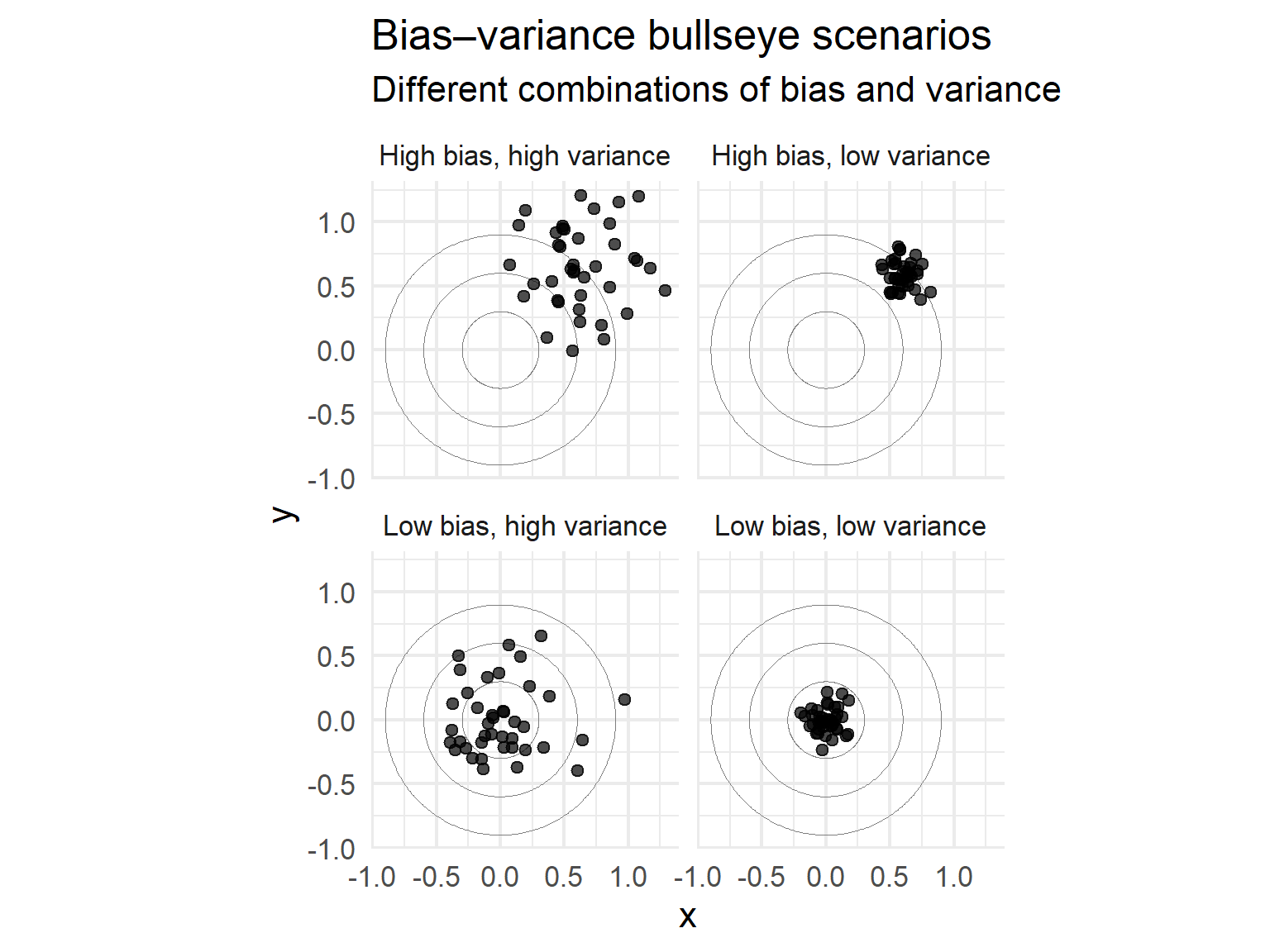
Bias–variance bullseye plots
Type I and Type II errors
Type I error (α)
A false positive — concluding an effect exists when it does not. We usually choose α = 0.05.
Type II error (β)
A false negative — failing to detect a real effect. Power = 1 − β measures how likely we are to detect the effect.
Typical scientific studies aim for 80% power, meaning β = 0.20.
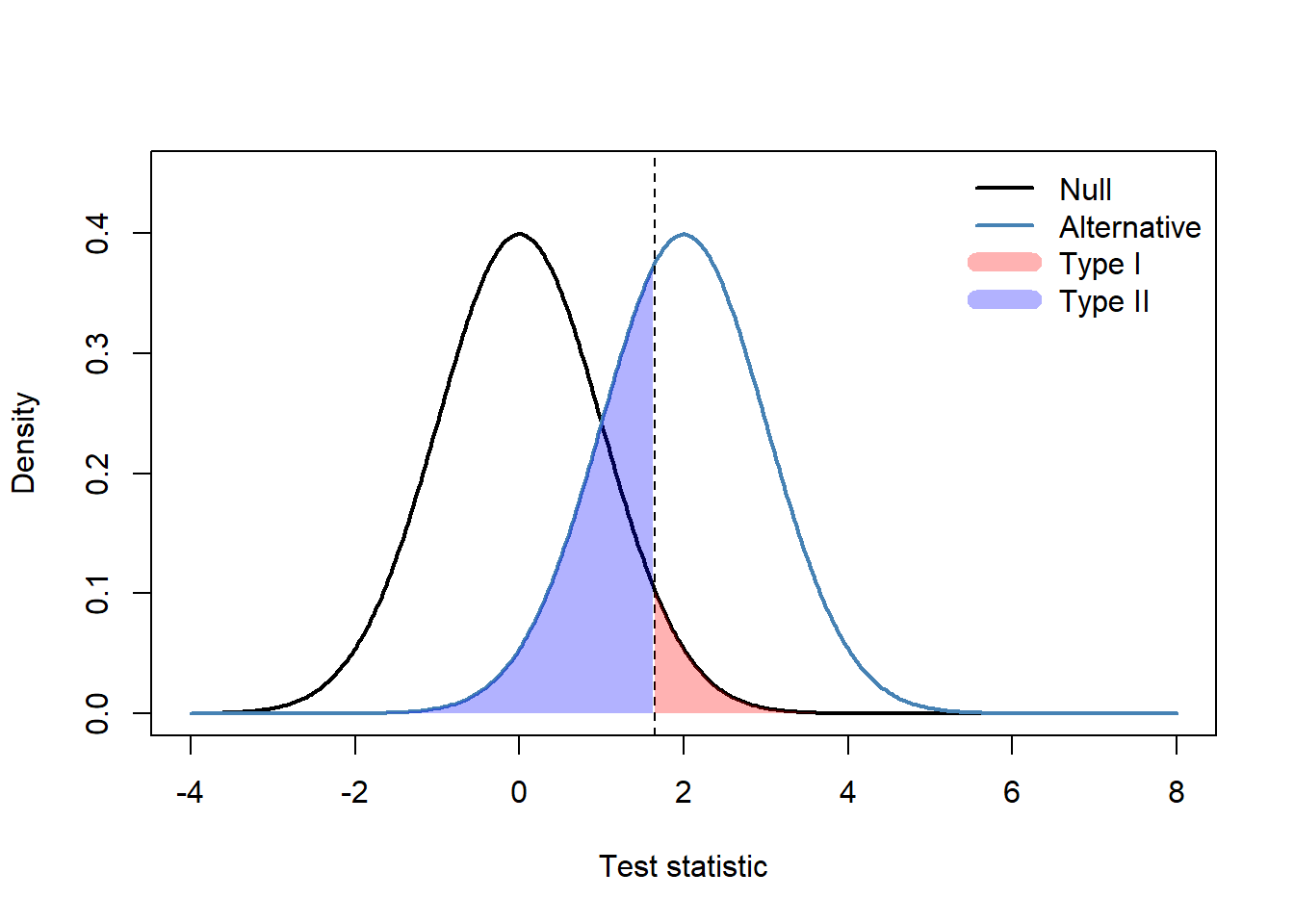
Type I and II error regions
Example: Power analysis in R
Below is an example power calculation for a two-sample t‑test when the effect size varies.
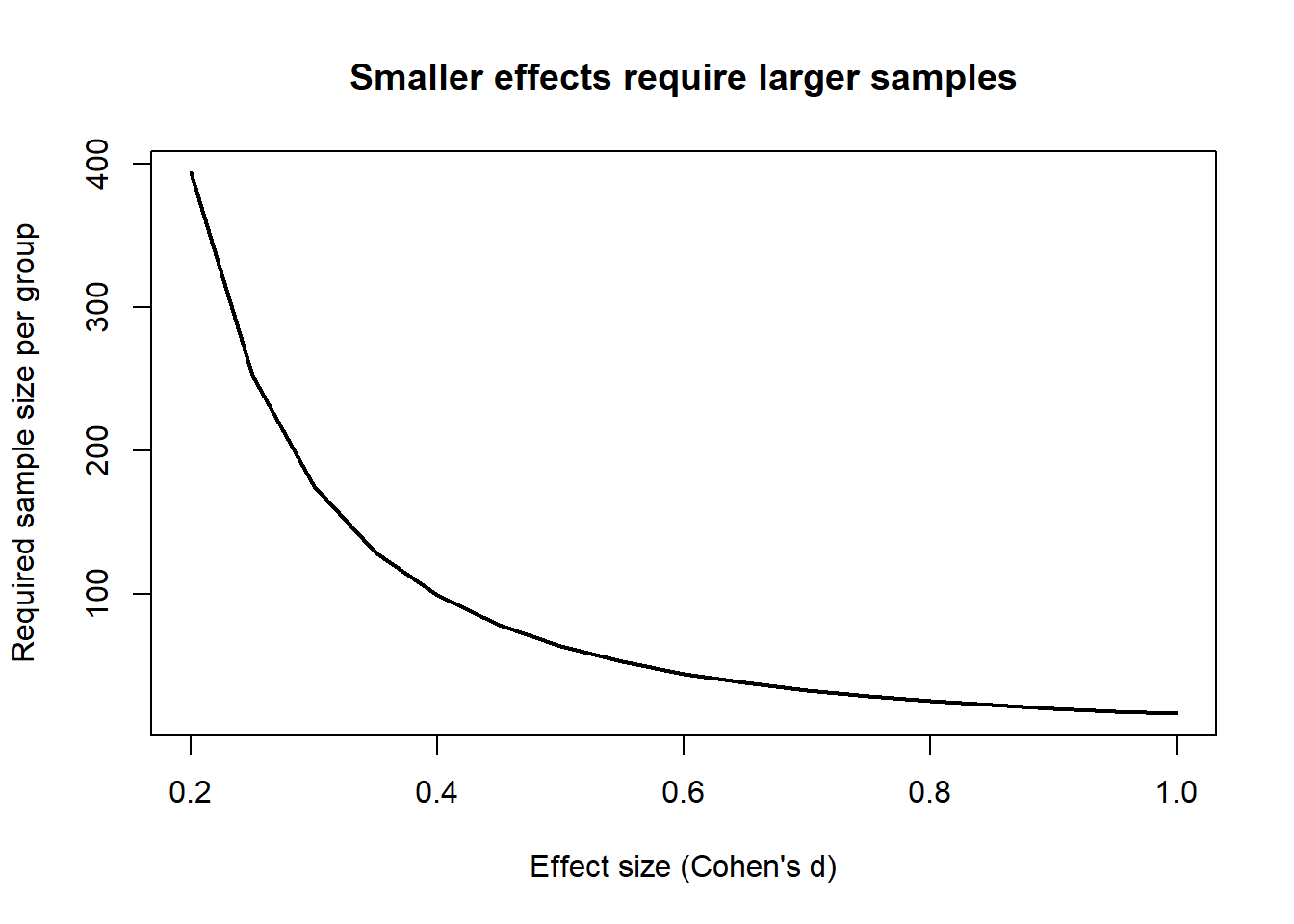
Required sample size as a function of effect size
Spatial example – create a study region in R
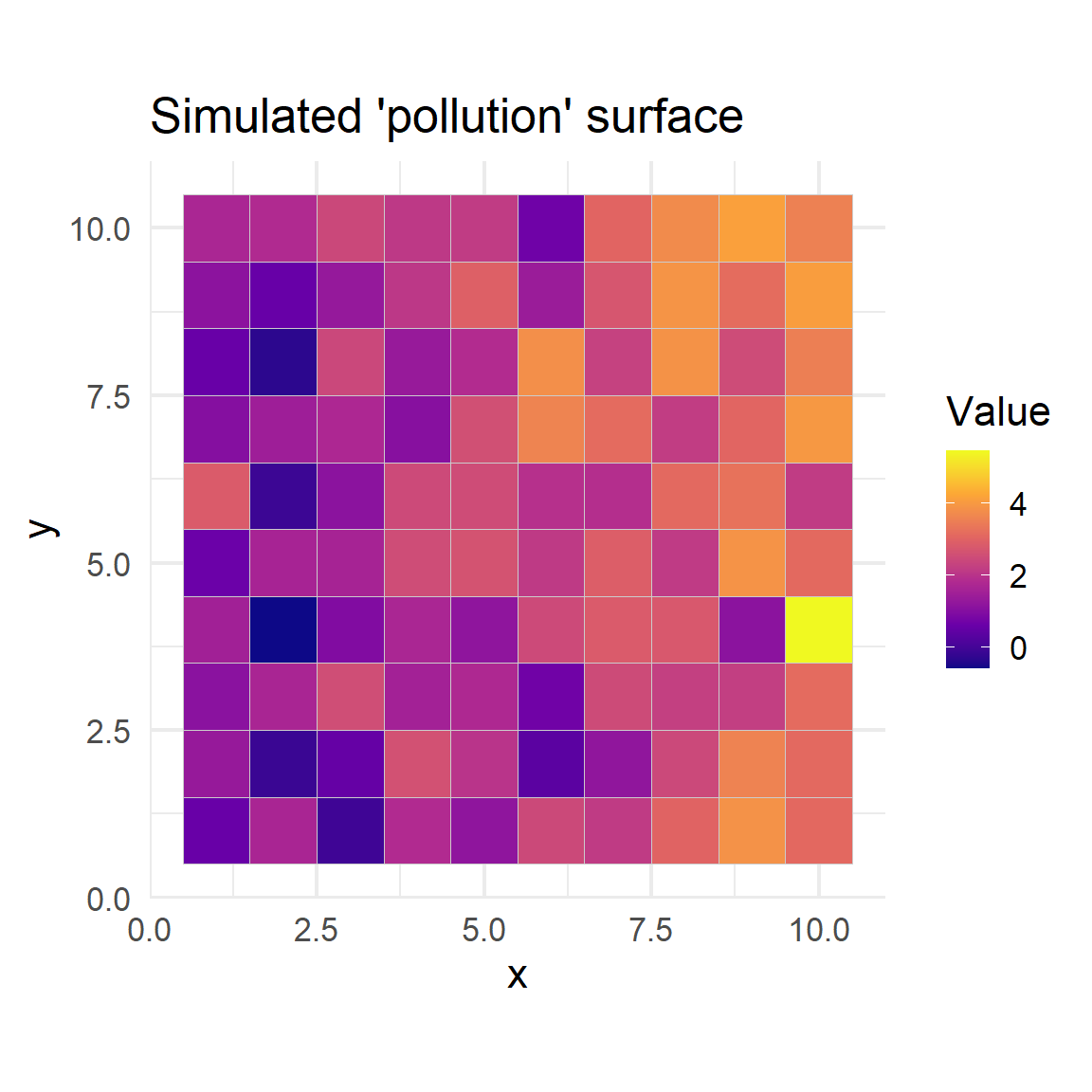
Simulated study region (grid)
Convenience sampling
Convenience sampling selects units that are easiest to reach or access, rather than using random or systematic selection.
This approach is often quick and low-cost, relying on availability rather than a defined sampling plan.
It does not ensure that every member of the population has a chance of selection, introducing selection bias.
As a result, the sample may not be representative, and findings may not generalize to the broader population.
In environmental studies, examples include sampling near roads, field stations, or other easily accessible sites.
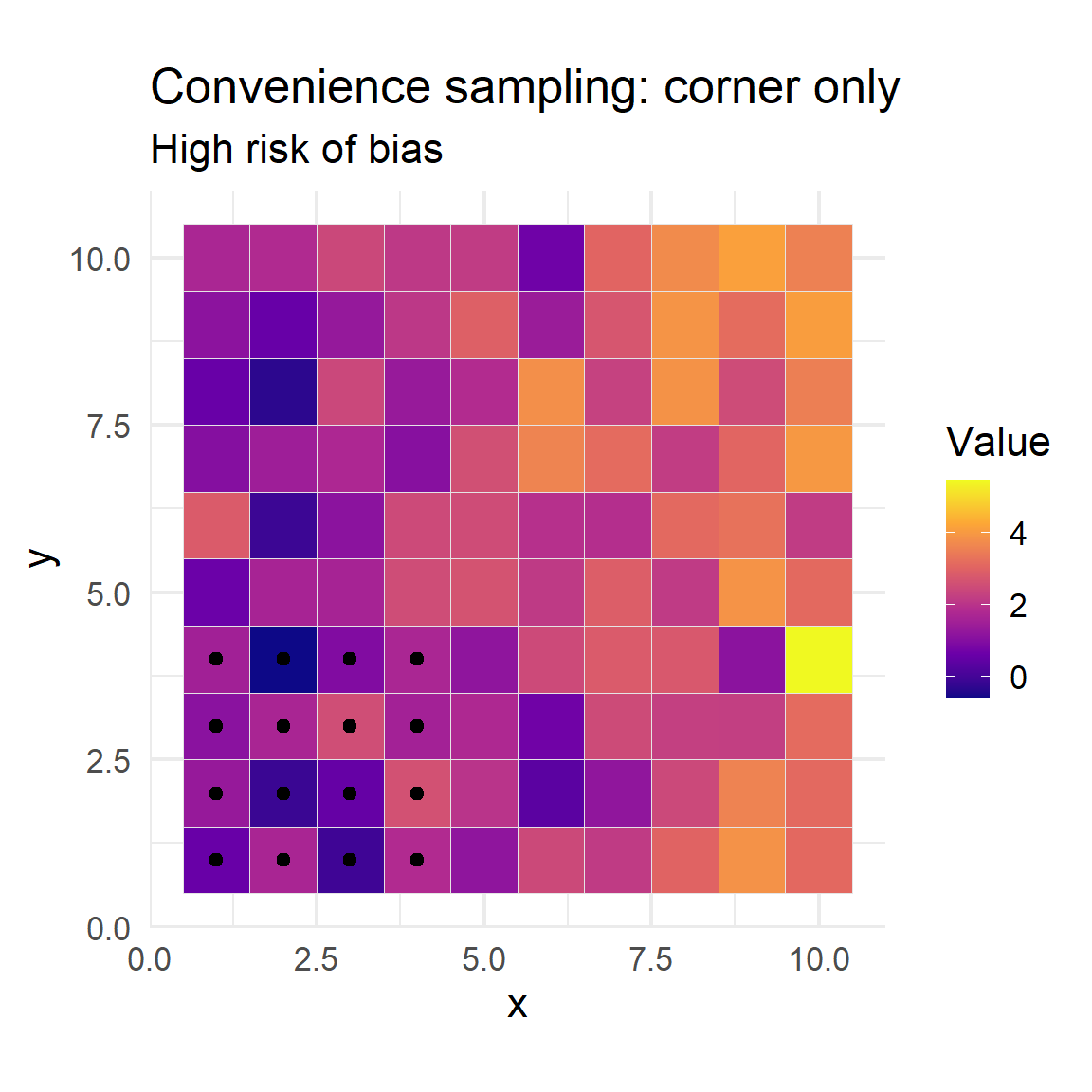
Convenience sample in the bottom-left area
Simple random sampling (SRS)
Simple Random Sampling (SRS) is a method where every unit in the population has an equal and independent chance of being selected.
SRS does not consider spatial, temporal, or group structure—samples are chosen uniformly from the entire sampling frame.
This approach is easy to implement and provides unbiased estimates as long as all units are accessible.
It may be inefficient in populations with strong spatial structure or gradients, potentially missing some areas entirely.
SRS requires a complete list of all units and may not be practical when access or sampling is logistically constrained.
n_srs <- 20

srs_sample <- grid |>
  sample_n(n_srs)

ggplot() +
  geom_tile(data = grid, aes(x, y, fill = value), color = "grey90") +
  geom_point(data = srs_sample, aes(x, y), color = "black", size = 2) +
  scale_fill_viridis_c(option = "C") +
  coord_equal() +
  labs(title = paste0("Simple random sample (n = ", n_srs, ")"), subtitle = "Unbiased under SRS", fill = "Value")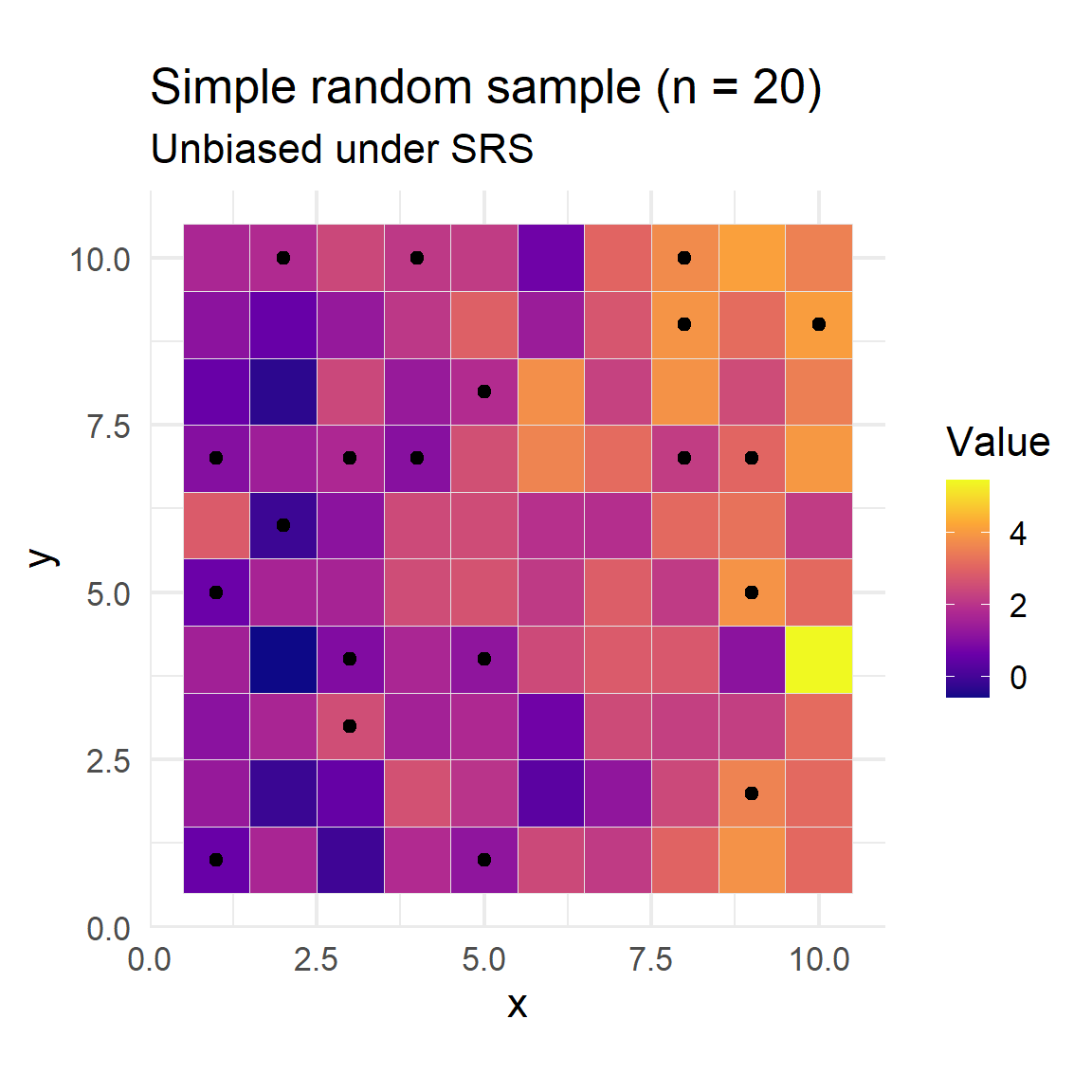
Simple random sample
Stratified sampling
Stratified sampling divides the population into distinct subgroups (strata) based on important characteristics (such as habitat, region, or demographic group).
Samples are randomly selected from within each stratum, ensuring that all segments of the population are represented in the final sample.
Improves precision of estimates, especially when there is substantial difference between strata but more similarity within each stratum.
The number of samples from each stratum can be proportional to its size or allocated equally, depending on study goals.
Analysis must account for stratification by appropriately weighting or aggregating results across strata to produce unbiased population-level estimates.
grid_strat <- grid |>
  mutate(
    stratum = cut(
      y,
      breaks = c(0, 3.33, 6.66, 10.1),
      labels = c("South", "Middle", "North")
    )
  )

n_per_stratum <- 8

strat_sample <- grid_strat |>
  group_by(stratum) |>
  sample_n(n_per_stratum) |>
  ungroup()

ggplot() +
  geom_tile(data = grid_strat, aes(x, y, fill = value), color = "grey90") +
  geom_point(data = strat_sample, aes(x, y, shape = stratum), color = "black", size = 2) +
  scale_fill_viridis_c(option = "C") +
  coord_equal() +
  labs(title = "Stratified sampling", subtitle = "Better coverage across landscape", fill = "Value", shape = "Stratum")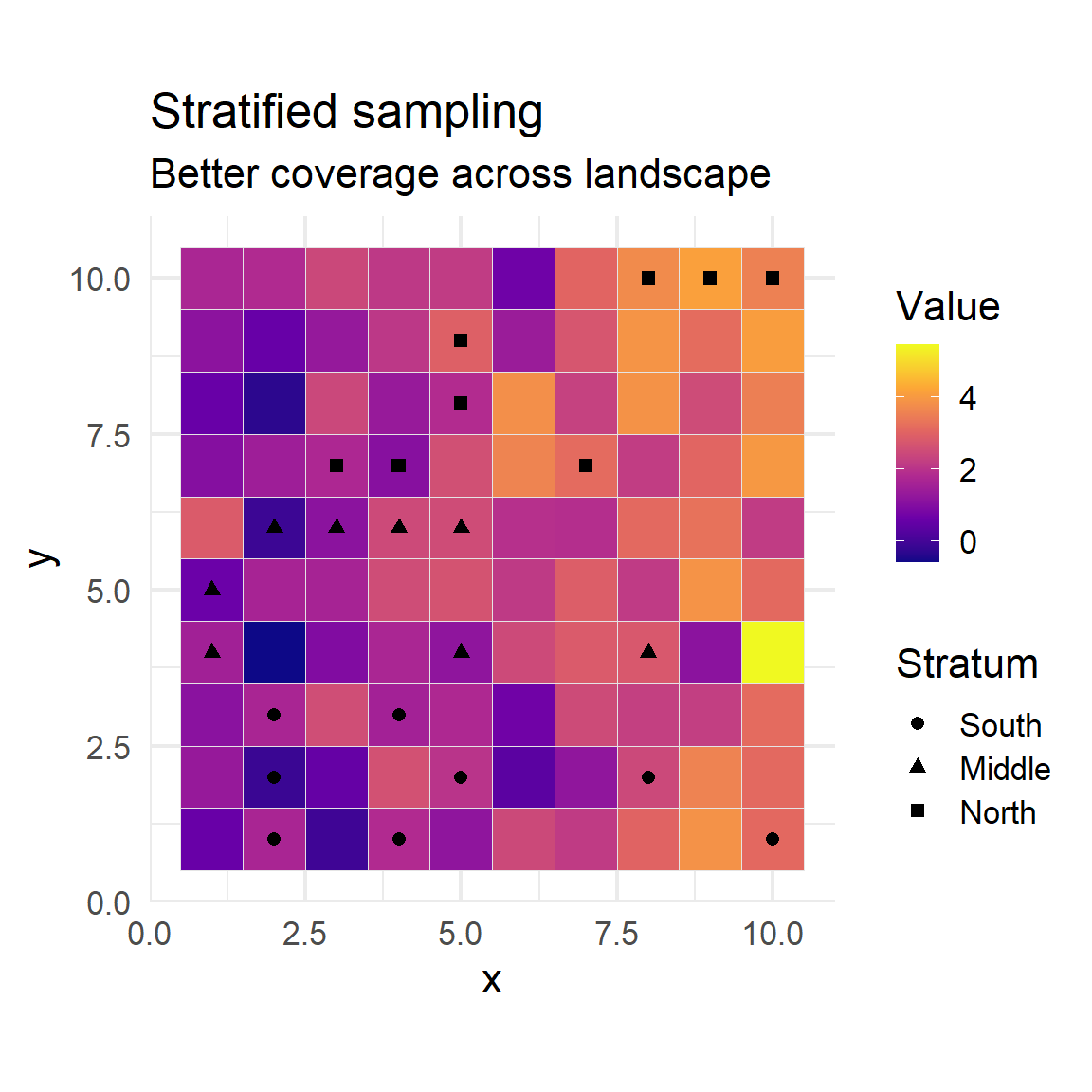
Stratified sampling by north/south bands
Cluster sampling
Cluster sampling groups the population into clusters (e.g., spatial blocks, villages, or schools) that are often based on natural or convenient divisions.
Randomly selects entire clusters, then samples all (or a subset of) units within those chosen clusters, rather than drawing from the population at large.
Reduces cost and logistical effort, since sampling is concentrated in a small number of locations, making it practical for widely dispersed populations.
Works best when clusters are similar to each other but internally heterogeneous, so that each selected cluster is representative of the whole population.
Statistical analysis must account for the cluster structure, as observations within clusters may be more alike—this increases sampling error compared to simple random sampling.
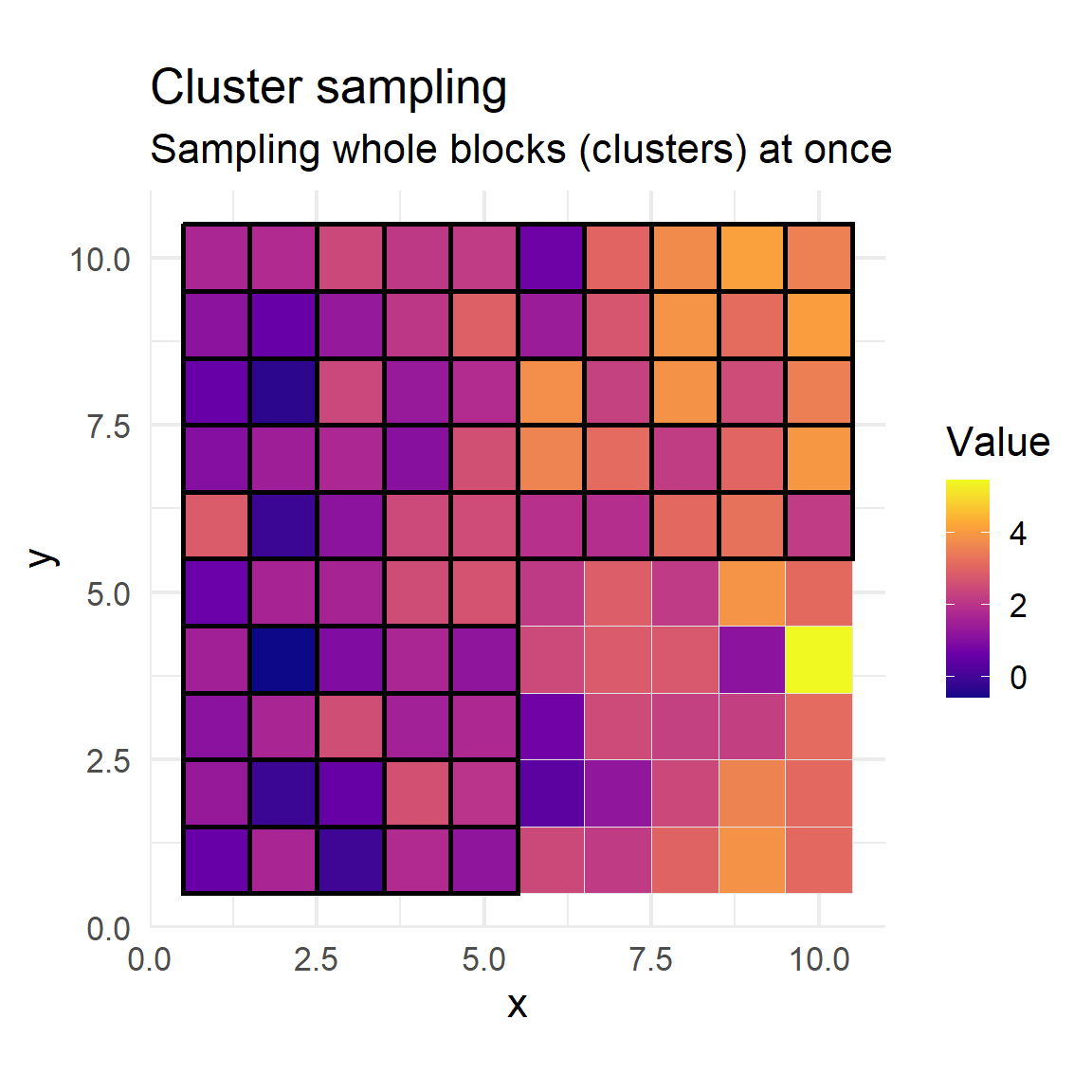
Cluster sampling using 5×5 blocks
Statistical Methods – Example: k-means Clustering
- k-means is an algorithm that partitions units into (k) clusters so that units within a cluster are more similar to each other than to those in other clusters.
- Steps:
- Specify number of clusters ((k)).
- Randomly assign initial cluster centers.
- Assign each unit to the nearest center.
- Update centers and repeat until stable.
- Application: Often used to create clusters or strata using continuous auxiliary variables (e.g., income, environmental gradients).
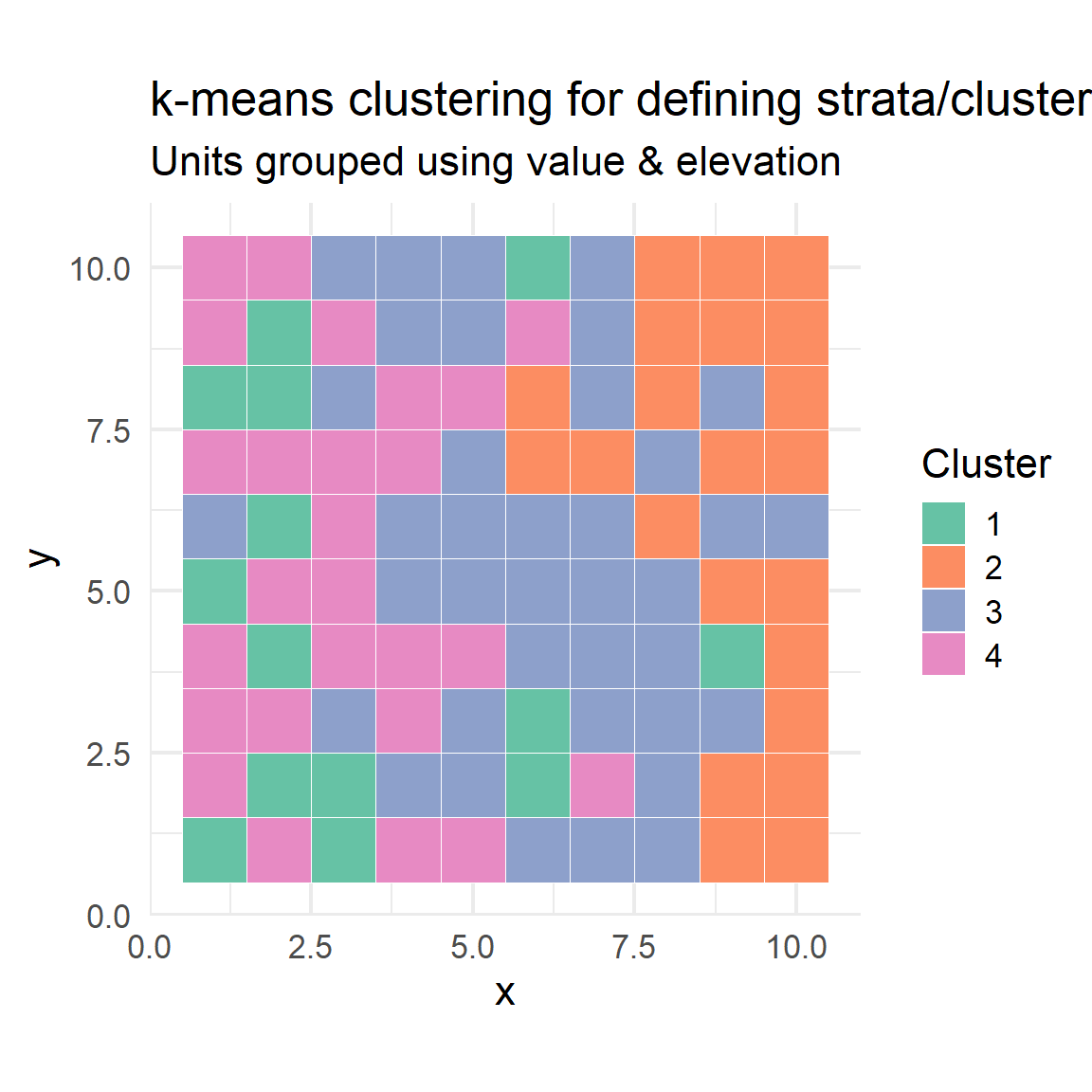
Creating strata/clusters using k-means clustering on two variables